Which Appliances Are Driving Up Your Electric Bill — and What to Look for When Buying New Ones
Why Your Electric Bill Keeps Climbing
If you're a Filipino homeowner staring at a Meralco bill that seems to grow every month, you're not imagining it. Residential electricity rates in the Philippines are among the highest in Southeast Asia — hovering around PHP 12 to PHP 14 per kWh depending on your utility.
But the rate is only half the story. The other half is what's plugged into your walls. A few appliances account for the bulk of your consumption, and if you bought them without checking the energy label, you could be paying thousands of pesos more per month than you need to.
This guide breaks down the biggest energy hogs in a typical Filipino home, what they actually cost to run, and — most importantly — what features to look for when it's time to buy a replacement.
1. Air Conditioner — The Biggest Energy Hog

No surprise here. In the Philippine heat, aircon is practically a necessity, and it's almost always the single biggest line item on your electric bill.
How much does it cost to run?
A 1.0 HP non-inverter window-type unit running 8 hours per night draws about 1,000 watts. At PHP 12/kWh, that's roughly PHP 2,880 per month — for one unit. A 1.5 HP unit in a larger room can easily hit PHP 4,000+.
An inverter split-type unit of the same capacity draws around 650 watts average, bringing the monthly cost down to about PHP 1,870 — a saving of over PHP 1,000 per month.
What to look for when buying:
- Inverter compressor — the single most important feature. Inverter units adjust speed continuously instead of switching fully on and off, using 30-50% less energy.
- EER (Energy Efficiency Ratio) — check the yellow DOE energy label. A higher EER means more cooling per peso. Look for at least 4 stars.
- Correct sizing — an undersized unit runs at full blast constantly; an oversized unit short-cycles and wastes energy. Rule of thumb: 1.0 HP per 12 sqm of floor area.
- R32 refrigerant — more energy-efficient than the older R22 or R410A, with lower global warming potential.
- Timer and sleep mode — gradually raises the temperature overnight, using significantly less energy than running at full blast until morning.
2. Refrigerator — The 24/7 Runner

Your ref doesn't draw as much power as your aircon at any given moment, but it runs every hour of every day. That adds up fast.
How much does it cost to run?
A standard two-door non-inverter refrigerator (8 cu ft, ~160W) costs around PHP 1,400 to PHP 1,650 per month. Larger models or older units with worn-out seals can run even higher.
An inverter ref of the same size draws 40-50% less, bringing the monthly cost down to PHP 700-900.
What to look for when buying:
- Inverter compressor — adjusts speed based on cooling demand rather than cycling fully on/off. The single biggest energy saver.
- Right size for your household — a ref that's too large wastes energy cooling empty space; too small forces the compressor to work harder. For a family of 4-5, 8-10 cu ft is typically sufficient.
- Energy label stars — check the DOE yellow label. Four or five stars means highest efficiency. Compare estimated monthly kWh between models.
- Door seal quality — a weak seal lets cold air escape constantly. Test by closing the door on a piece of paper — if you can pull it out easily, the seal needs replacing.
- Placement — keep your ref away from heat sources (stove, direct sunlight, wall with no ventilation). A ref in a hot corner works much harder.
3. Washing Machine — The Hidden Cost
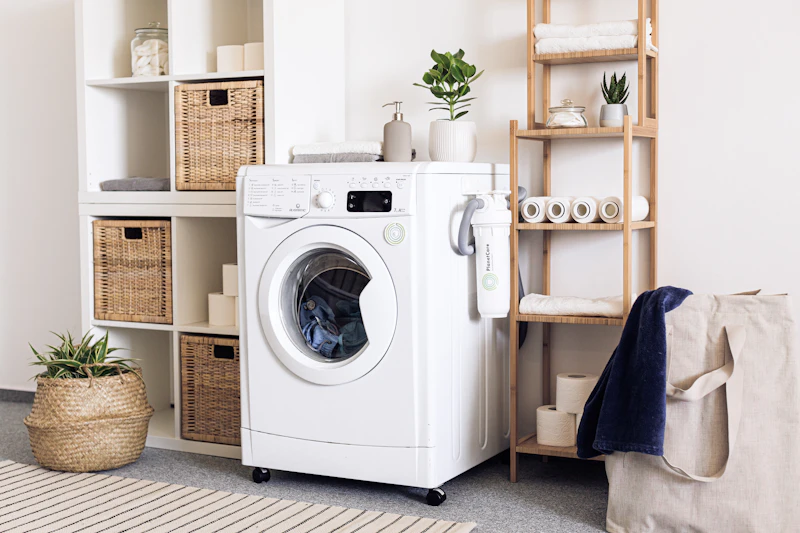
Washing machines don't run 24/7, but when they do run, they draw significant power — especially if they heat water.
How much does it cost to run?
A top-load non-inverter washing machine (500W motor) used daily costs about PHP 180-250 per month. But a machine with a built-in heater on warm/hot wash can spike to 2,000W per cycle, pushing monthly costs past PHP 700.
What to look for when buying:
- Inverter motor — uses 20-30% less energy than conventional motors and runs quieter.
- Front-load vs top-load — front-loaders use 40-50% less water, which matters if you're heating water. For cold-wash only (common in PH), the difference is smaller but front-loaders still tend to be more efficient.
- Load capacity — buy for your actual household needs. Running a half-empty large machine wastes water and energy. For a family of 4-5, 7-8 kg is usually right.
- Cold wash capability — most clothes clean fine in cold water with modern detergent. A machine that defaults to cold wash saves energy every cycle.
- Spin speed — higher RPM (1200+) means clothes come out drier, reducing dry time and mold risk during rainy season.
4. Electric Water Heater — The Silent Guzzler
Storage-type electric water heaters are deceptively expensive to run. They keep 10-30 liters of water hot even when no one is showering.
How much does it cost to run?
A 30-liter storage heater with a 1,500W element costs roughly PHP 600-1,000 per month. An instant (tankless) heater draws more power (3,500-4,500W) but only while water is flowing, which can actually be cheaper if showers are short.
What to look for when buying:
- Instant/tankless type — no standby losses since there's no tank to keep hot. You only pay for the minutes you're actually using hot water.
- Insulation quality (if buying storage type) — polyurethane foam insulation loses less heat than fiberglass.
- Timer or schedule feature — heats water only before your usual shower times rather than all day, cutting costs by 40-60%.
- Consider solar water heating — highly effective in the Philippines and can eliminate electric water heating costs entirely. Payback period is typically 2-3 years.
5. Other Appliances Worth Watching
These don't run long enough to match the aircon or ref, but they draw significant power when they're on:
- Electric iron (1,000-2,000W) — ironing 30 min daily costs PHP 180-360/month. Iron in batches to reduce heat-up cycles.
- Rice cooker (300-700W cooking, 30-80W keep-warm) — left on keep-warm all day can cost PHP 150-200/month. Turn off keep-warm after an hour; reheat in the microwave instead. IH (induction heating) models cook faster and use less energy.
- Electric stove/induction cooktop (1,200-2,000W per burner) — can rival your aircon bill if you cook extensively. Induction cooktops are 85-90% efficient vs 65-70% for traditional electric. The clear winner for new setups.
- Electric fan (35-75W) — cheap at PHP 30-65/month, but 3-4 fans add up. Ceiling fans move more air and can let you raise the aircon thermostat by 2-3 degrees.
- Microwave oven (800-1,200W) — usually under PHP 100/month. Actually more efficient than reheating on a stove for small portions.
6. How to Read the Philippine Energy Label
The Department of Energy requires an energy label on air conditioners, refrigerators, and other major appliances sold in the Philippines. Learning to read it takes 30 seconds and can save you thousands of pesos.
What the label shows:
- Star rating (1 to 5 stars) — more stars means higher efficiency. Always compare within the same product category and capacity.
- Estimated monthly energy consumption (kWh) — multiply by your utility rate (e.g., PHP 12/kWh for Meralco) to get your estimated monthly cost.
- Estimated monthly operating cost (PHP) — the label does the math, but the rate used may not match your current utility rate. Do the multiplication yourself.
- Refrigerant type — for aircon and ref units. R32 is the current best choice for efficiency and environmental impact.
- QR code — newer labels link to detailed specs including greenhouse gas emissions data.
Pro tip: When comparing two models, calculate the monthly operating cost difference and multiply by 12. Over a 10-year lifespan, a unit that costs PHP 5,000 more but saves PHP 500/month will save you PHP 55,000 overall.
Quick Cost Comparison Table
Typical monthly electricity costs for common household appliances (based on Meralco rate of ~PHP 12/kWh):
| Appliance | Non-Inverter | Inverter |
|---|---|---|
| Air conditioner (1.0 HP, 8 hrs/day) | PHP 2,880 | PHP 1,870 |
| Refrigerator (8 cu ft, 24 hrs/day) | PHP 1,400-1,650 | PHP 700-900 |
| Washing machine (1 cycle/day) | PHP 180-250 | PHP 130-180 |
| Water heater (2 showers/day) | PHP 600-1,000 (storage) | PHP 300-500 (tankless) |
| Rice cooker (cook + keep warm) | PHP 150-200 | PHP 100-130 (IH) |
| Electric fan (8 hrs/day) | PHP 30-65 | PHP 15-30 (DC) |
The pattern is clear: inverter technology consistently cuts costs by 30-50%. The inverter version almost always pays for itself within 1-2 years.
The Bottom Line
You don't need to replace everything at once. Start with the appliance that runs the most hours — for most Filipino homes, that's the aircon or the ref. Upgrading just one to an efficient inverter model can shave PHP 500-1,000 off your monthly bill.
When shopping, bring your phone and do the math right in the store: check the energy label, multiply the monthly kWh by your actual utility rate, and compare across models. The cheapest unit on the shelf is rarely the cheapest unit to own.
And if your monthly bill is still north of PHP 3,000 after upgrading your appliances, solar panels become a serious option. A properly sized system can offset 70-80% of your remaining consumption, with a payback period of 3-5 years. Take our free solar assessment to see what makes sense for your home.
Ready to see if solar works for your home?
Our free assessment takes 2 minutes and gives you a personalized recommendation with system sizing, costs, and payback period.
Get Your Free Assessment